
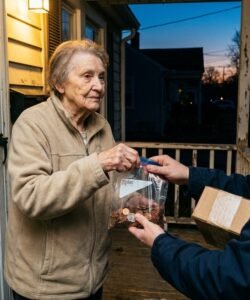
She handed me a sandwich bag filled with coins for a $14 pizza and whispered, “I think it’s enough.”
I was standing on a sagging wooden porch, wind slicing through my jacket. The delivery note had been simple: Back door. Knock loud.
It wasn’t quite a trailer park, but it wasn’t far off. One of those small houses at the edge of town with peeling siding and a yard that looked forgotten.
No lights were on.
I knocked.
“Come in!” a thin voice called from inside.
I pushed the door open. It was colder inside than out.
An elderly woman sat wrapped in quilts in a worn recliner. No television. No radio. Just a dim lamp and the slow sound of her breathing.
She stared at the pizza box like it was treasure.
“I’m sorry it’s so chilly,” she said, reaching for a plastic bag beside her. Her hands trembled. “I keep the heat off as long as I can. My heart medicine comes first.”
She held out the bag.
It was heavy with pennies.
“I counted it twice,” she added softly. “Mostly pennies… some nickels from the couch cushions. Is it enough?”
The total on my receipt was $14.50.
I didn’t take the bag.
Instead, my eyes drifted toward the kitchen. The refrigerator door sat slightly open.
Inside wasn’t cluttered.
It was empty.
A jug of tap water. A box of baking soda. A stapled pharmacy bag.
Nothing else.
She wasn’t ordering pizza for convenience. It was the cheapest hot meal she could have delivered. She didn’t have the strength to cook.
On the mantle, dusty frames showed her decades younger—in a nurse’s uniform from the 1970s.
She had spent forty-five years caring for other people.
Now she was sitting in the dark, choosing between heat, medicine, and food.
I swallowed hard.
“Actually, ma’am,” I said, forcing a smile, “our system glitched. You’re our hundredth order today. It’s free.”
She hesitated. “I don’t want you getting in trouble.”
“I’m the manager tonight,” I lied. “It’s taken care of.”
I placed the box on her lap. When she opened it, the steam brushed her face. She closed her eyes and inhaled deeply. A tear slid down her cheek.
I walked back to my car but didn’t start it.
Instead, I texted dispatch: Flat tire. Need 45 minutes.
Then I drove to the big store down the road.
I didn’t buy snacks.
I bought what mattered.
Milk. Eggs. Soft bread. Canned soup with easy-open tabs. Oatmeal. Bananas. A warm rotisserie chicken.
When I returned, she was on her second slice, eating like she hadn’t had a proper meal in days.
I unpacked the groceries onto her small kitchen table.
She stared at them in disbelief.
“What is all this?” she whispered.
“My grandmother lives alone too,” I said, placing the milk in the fridge. “If she were sitting in the dark somewhere, I’d hope someone would do the same.”
She tried to move toward me but couldn’t navigate past the rug.
So I went to her.
She gripped my hand and pressed it to her forehead, sobbing.
“I worked my whole life,” she said through tears. “I did everything right. I don’t understand how it came to this.”
I stayed awhile. I checked the windows for drafts. Replaced a burned-out bulb in the hallway. Turned the thermostat up.
“The bill…” she started.
“Tonight doesn’t need to be about the bill,” I said gently.
I left with less cash than I started with.
But here’s what stayed with me:
We live in a country of staggering wealth. There are rockets launching into orbit. Apps that can deliver dinner in minutes.
And yet a retired nurse was stretching pennies to afford one warm meal.
Check on your neighbors.
Especially the quiet ones.
The ones whose houses are dark.
Because pretending not to see them doesn’t make them disappear. It only makes us look away.